Your sales meeting went well. The prospect likes your offer and wants a proposal. Three days later, your team is still checking prices, chasing project details and formatting slides. Another vendor has already sent theirs.
An AI proposal generator can shorten that delay. It helps teams draft proposals, organise requirements and tailor content without starting from scratch. But attractive documents alone do not win business. The information behind them must be accurate, relevant and easy for buyers to act on.
AI is already part of everyday business. McKinsey’s 2025 State of AI report found that 71% of respondents said their organisations regularly used generative AI in at least one business function. Marketing and sales were among its common applications.
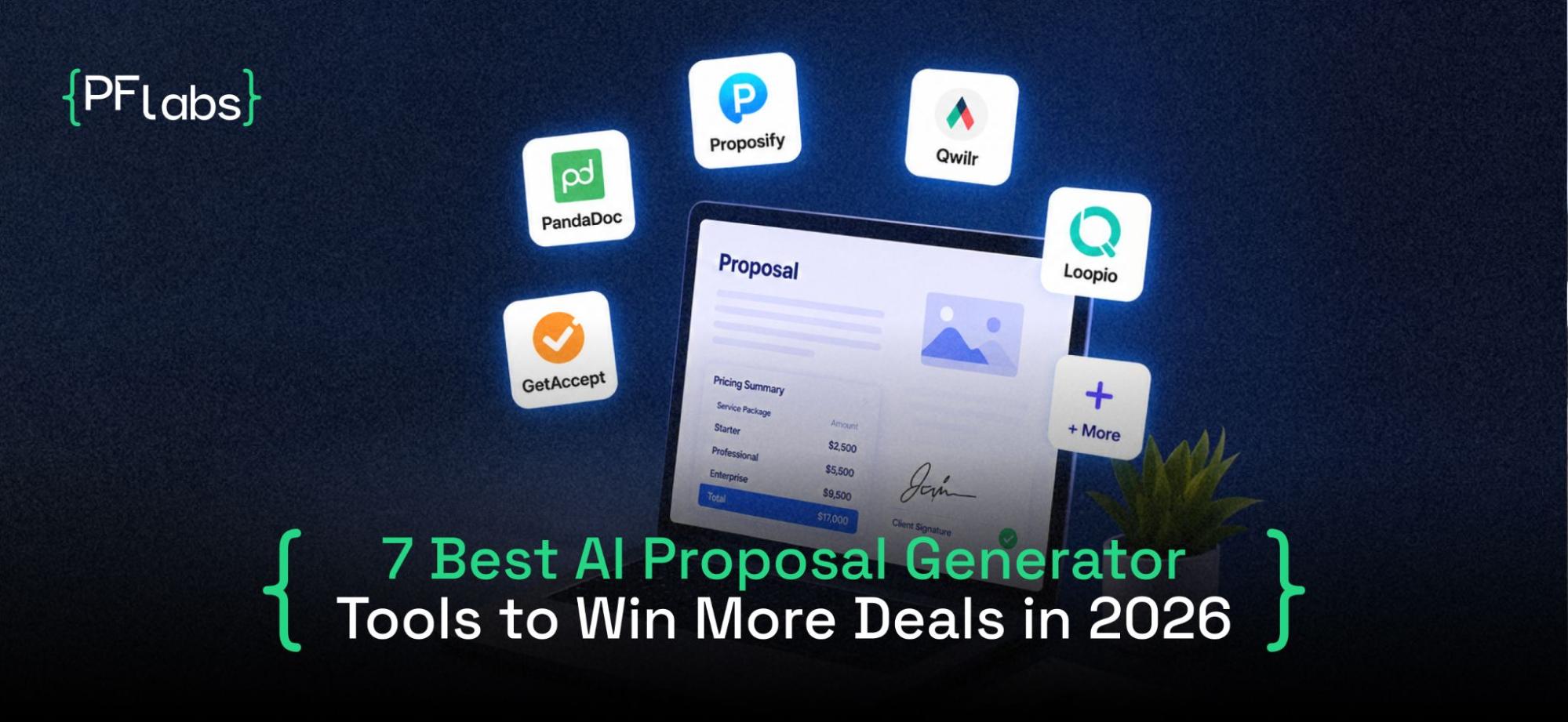
Here are seven tools that address different parts of the proposal process.
What Is an AI Proposal Generator?
An AI proposal generator uses prompts, client requirements or existing materials to create proposal content. Depending on the product, it can draft executive summaries, scopes of work, timelines and pricing explanations.
An AI business proposal generator may also draw on company information to personalise an offer. Other platforms focus on design, approvals, signatures or responses to formal requests for proposals (RFPs). The right choice depends on where your team loses time.
7 Best AI Proposal Generator Tools
1. PF Labs
Best for: Enterprise research and proposal preparation
PF Labs addresses the work that happens before a proposal reaches the page. Its enterprise AI capabilities help teams access organisational knowledge, research prospects, and automate repetitive processes.
Company Brain supports access to knowledge across connected business systems. Deep Research helps teams assemble structured findings from relevant information. Together, these capabilities can strengthen project context and produce more informed proposal drafts.
Key features:
- Connected organisational knowledge
- Source-backed business research
- AI agents and workflow automation
- Enterprise system integrations
For B2B teams handling detailed opportunities, PF Labs can reduce the time spent hunting for internal information. It is especially relevant when research, coordination, and fragmented knowledge are bigger obstacles than formatting.
Limitation: PF Labs is not a dedicated proposal editor or electronic-signature platform.
2. PandaDoc
Best for: Sales proposals and signatures
PandaDoc combines document creation, pricing tables, approval workflows and electronic signatures. Its AI writing tools assist with drafting and editing, while templates help sales teams maintain consistent documents.
Key features:
- AI-assisted writing
- Reusable templates and pricing tables
- Document tracking and electronic signatures
- CRM integrations
For teams seeking an AI sales proposal generator, PandaDoc is useful when the priority is moving from draft to signed agreement within one system.
Limitation: Some advanced workflows require higher-tier subscriptions.
3. Proposify
Best for: Branded proposals for agencies
Proposify helps agencies and service businesses create consistent proposals using approved content, templates and customizable pricing. AI-assisted drafting can turn rough project notes into polished sections. Teams can also track client engagement and collect signatures.
Key features:
- Branded templates
- AI-assisted proposal content
- Interactive pricing
- Tracking and signatures
It suits businesses sending similar offers to multiple prospects while maintaining control over presentation and messaging.
Limitation: Extensive research may still require a separate platform.
4. Qwilr
Best for: Interactive web proposals
Qwilr presents proposals as interactive webpages rather than conventional attachments. Buyers can review visual content and pricing options in one place. Teams can monitor engagement and collect signatures.
Key features:
- Web-based proposals
- AI-assisted content creation
- Interactive pricing
- Engagement analytics
Qwilr works well when the buying experience matters and prospects need to explore several service options.
Limitation: Some procurement teams still require conventional document formats.
5. Better Proposals
Best for: Small businesses and consultants
Better Proposals simplifies proposal preparation with professional templates, reusable sections, tracking and electronic signatures. It is a practical option for straightforward service offers where speed and clarity matter more than complex enterprise workflows.
Key features:
- Ready-made templates
- Reusable document content
- Proposal tracking
- Electronic signatures
For teams comparing an AI project proposal generator, it offers a straightforward way to present deliverables, schedules and pricing.
Limitation: It is less suited to complex, research-heavy enterprise bids.
6. Storydoc
Best for: Visual sales presentations
Storydoc creates interactive proposals and sales presentations. Its AI-assisted content and customizable layouts help businesses explain complex offerings through a more engaging format. Engagement insights show how recipients interact with the material.
Key features:
- AI-assisted proposal creation
- Interactive layouts
- Personalized presentations
- Engagement analytics
Storydoc suits agencies and technology businesses that need to communicate value visually.
Limitation: Its design capabilities may be unnecessary for basic text proposals.
7. Loopio
Best for: Enterprise RFP responses
Loopio helps organisations answer lengthy RFPs and questionnaires using a central library of approved information. AI-assisted response workflows and collaborative reviews can reduce repetitive writing across sales, legal and technical teams.
Key features:
- Centralised answer library
- AI-assisted RFP responses
- Collaborative reviews
- Reusable approved content
Loopio is useful when accuracy, consistency and contributions from several departments are essential.
Limitation: Its RFP capabilities may be excessive for occasional proposals.
Before choosing, ask who will maintain the information behind each proposal. A template is useful only if its numbers, case studies and service descriptions stay current. Assign owners to approved content, review sensitive claims and keep a clear approval step for client commitments. That discipline matters whether your team sends five proposals a month or fifty. It also prevents a polished AI draft from repeating an outdated promise to a potential customer.
AI Proposal Generator Tools Compared
| Tool | Best for | Main strength |
|---|---|---|
| PF Labs | Enterprise preparation | Research and connected knowledge |
| PandaDoc | Sales teams | Documents and signatures |
| Proposify | Agencies | Branded proposals |
| Qwilr | Interactive selling | Web proposals |
| Better Proposals | Small businesses | Simple workflows |
| Storydoc | Visual pitches | Interactive presentations |
| Loopio | Enterprise RFPs | Approved responses |
How to Choose the Right Tool
Start with the real bottleneck. Do you struggle to find accurate customer information, write compelling content, obtain internal approvals or get signatures?
Integration matters, too. Salesforce’s 2026 State of Sales report stated that 51% of sales leaders using AI said disconnected systems were slowing their AI initiatives. Proposal teams should therefore examine how tools connect with their CRMs, documents and internal knowledge.
Evaluate proposal complexity, editing flexibility, security, human approval controls and total cost. A free AI proposal generator might be enough for an occasional draft, but advanced collaboration, integrations and signatures often come with paid plans.
Can AI-Generated Proposals Actually Win Deals?
An AI-generated document is not a sales strategy. Winning proposals address specific buyer problems, make deliverables clear and explain value in language customers understand.
A good proposal generator AI workflow can speed up research and first drafts. People still need to verify pricing, promises, timelines and contract terms. The strongest teams use AI to prepare better, not to skip judgment.
Build Better Proposals With PF Labs
Proposal writing is only the visible part of the job. Teams also need reliable research, relevant client context and access to information scattered across systems.
PF Labs helps address that groundwork through Company Brain, Deep Research and AI agents. For organizations handling complex opportunities, connected knowledge and automation can make proposal preparation more informed and less manual.
Stop losing sales time searching for information. Book a demo with PF Labs to see how enterprise AI can support the work behind your next proposal.